Ironic that Debi of Shearwater Journeys described her trips on the Calbirds listserv this morning as "friendly, inclusive," and then she proceeds to direct readers to her blog with the heading, "Monterey Seabirds with Shearwater Journeys." This is what is known as meta tagging to direct web searches to her website by using the name of a competitor in the heading of the blog post.
Apparently there is nothing illegal about doing that. I could do it too (actually I am doing just that right now) but I'm sorry it just seems slimy. Of course this isn't the first time. It was done repeatedly on her blog last year. It isn't as egregious using our name in the heading for her ads in Winging It magazine. "Monterey Seabirding with Shearwater Journeys.
Her website schedule page is headlined, "Monterey Seabirding with Shearwater Journeys."
I have a lot of respect for Debi. Her stamina in doing so many pelagics trip per year is impressive and I have tried to work with her schedule to avoid conflicting dates but this sort of behavior is vexing.
Nobody likes being bullied and that's why we're here.
Best,
Roger for Monterey Seabirds
Wednesday, June 6, 2012

Sunday, November 6, 2011
October 29th Laysanpalooza
 |
| Laysan Albatrosses |
It was either Ken Petersen or Glen Tepke who dubbed this trip Laysanpalooza. The trip highlight being three LAYSAN ALBATROSS, two of them at once and a third later in the day. Once again we found a FLESH-FOOTED SHEARWATER which we found on almost every trip out of Monterey this season. We also got some up close looks and got to hear the vocalizations of two XANTUS'S MURRELETS (scrippsi).
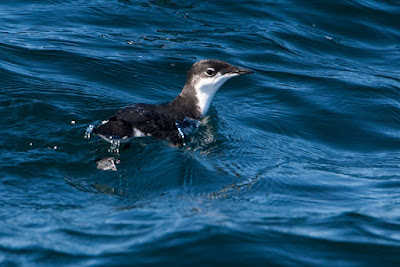 |
| Xantus's Murrelet |
Lots of photographers on board today. I had considered a photo contest but Martijn Verdoes has that lens that everyone wants to own but no one wants to pay for. You have to admit he gets some pretty amazing shots with it. All photos are copyrighted and can be used by permission only Martijn Verdoes/Agami.nl
 |
| Black-footed Albatross |
Martijn will be heading back to Holland soon. We will miss him and his great seabirding ability and photography. Thanks for all your help Martijn!
Don Roberson's eBird reports:
Monterey Bay pelagic (MTY Co.), Monterey, US-CA
Oct 29, 2011 8:30 AM - 2:45 PM
Protocol: Traveling
50.0 mile(s)
Comments:     aboard 'Pt Sur Clipper' on Monterey Seabirds trip with Richard Ternullo, skipper; Roger Wolfe, Dan Singer, Martiijn Verdoes, Tim Amaral, Blake Matheson (and reporter D. Roberson); Ken Peterson, Peter LaTourrette, Tom Grey, Sarah Lane, Jeff Poklen, Don Glasco, John Cant, Tom Malone, Jackie Weller, Pete Sole, Glen Tepke et al. Very sunny but rather cold (at least in a.m.), with large swells offshore (6-8'). Beaufort 2 conditions in a.m. with wind out of the east (and inner Bay flat calm) but wind picking up to Beaufort 4 in afternoon return. Route was to Pt. Pinos (see inshore checklist; we spent quite some time within 1 nmi of shore, looking at a feeding group of Grampus), then west out 18 miles, a bit northwest but turned south beofre entered SCZ waters; then SW to 22 nmi W of Cypress Pt., and return via Pt. Pinos and inshore see separate checklist for the combined inshore legs.). Compared to a comparatively birdless day last Sunday, numbers of shearwaters were up again (although fulmars were down). Pretty birdy all day, but no whales. Mixed swell & chop many conditions difficult for small alcids etc. This checklist only species encountered >1 mile offshore; today, a few Brandt's Cormorants and pelicans were offshore, but guillemot, Elegant Terns, migrant coots all 'inshore.'
24 species (+2 other taxa)

Surf Scoter  8
Pacific Loon  7
Laysan Albatross  3     two came to boat ~8 nmi W of Cypress Pt., at 36°40.082'N, 122°06.488' W [=36.668944, -122.113556] and hung around a long time after Roger put  out a slick. Many photos. The 3rd bird was ~3.52 nmi W of Pt. Joe [at 36°38.228N, 122°01.503W = 36.639667, -122.030639] and continued to come back at us, probably last seen ~3 nmi off Pt. Pinos. Also photo'd. None seemed to be banded (need to double-check photos)
Black-footed Albatross  12     some followed us for hours; I think 12 is minimum, could have been more
Northern Fulmar  50     down from last weekend
Pink-footed Shearwater  85
Flesh-footed Shearwater  1     photo'd
Buller's Shearwater  25
Sooty Shearwater  7     numbers way down
Brandt's Cormorant  6     beyond 1 nmi offshore (many more inshore)
Brown Pelican  5     beyond 1 nmi offshore (many more inshore)
Peregrine Falcon  1     11.5 nmi offshore (distant photo), and heading west!
Red-necked Phalarope  2
Red Phalarope  4
Bonaparte's Gull  12
Heermann's Gull  5
Western Gull  50
Western x Glaucous-winged Gull (hybrid)  1
California Gull  200
Herring Gull (American)  1     adult
Herring x Glaucous-winged Gull (hybrid)  1     first-cycle, best guess at i.d.
Pomarine Jaeger  9     including at least one full-tailed adult
Common Murre  40
Xantus's Murrelet (scrippsi)  2     14 nmi W of Cypress Pt.; vocalizing 'pair' separated accidentally by the boat; presumably a father/full-grown chick duo.
Cassin's Auklet  60
Rhinoceros Auklet  15
Inshore report for eBird:
This checklist only species encountered <1 mile offshore, and includes birds on the jetty, the Aquarium tower, and the egrets/herons standing on kelp beds (but not land birds in the harbor).
23 species

Eared Grebe  8
Northern Fulmar  1
Brandt's Cormorant  250
Double-crested Cormorant  1
Pelagic Cormorant  1
Brown Pelican  25
Great Blue Heron  1
Great Egret  3
Snowy Egret  2
Peregrine Falcon  1     sitting on Aquarium tower
American Coot  95     big flock of ~80 in a pack a half-mile off the Aquarium on calm seas; 2 more out as far as 0.75 nmi offshore (checked with skipper on that location), then inbound in p.m., a dozen more about a half-mile W of Pt. Pinos. Very odd to see coots on the ocean, but all were within a mile of shore.
Black Turnstone  4
Bonaparte's Gull  15
Heermann's Gull  50
Mew Gull (American)  2
Western Gull  100
California Gull  100
Glaucous-winged Gull  1
Elegant Tern  6
Common Murre  20
Pigeon Guillemot  1     juv
Cassin's Auklet  5
Rhinoceros Auklet  1

This report was generated automatically by eBird v3 (http://ebird.org)
Monday, October 17, 2011
Oct. 15 trip report
The table is set, the warm water break at Sur Ridge looks reachable and tempting on the sea surface temperature map. Only problem being the southeast wind has come up and now our windows are getting wet so we have to change course to keep from getting ourselves into an ugly situation. Fortunately the sea is alive with seabirds
PINK-FOOTED SHEARWATERS are particularly numerous this morning outnumbering the SOOTIES by a wide margin. (photos copyright Blake Matheson, by permission only)
 |
| Pink-footed Shearwater |
I’m glad we have so many spotters on board today because the tubenoses just keep coming. It is a lot of work to go through all the BLACK-FOOTED ALBATROSS and NORTHERN FULMARS and SOOTY, BULLER’S and three FLESH-FOOTED SHEARWATERS. A couple of SHORT-TAILED SHEARWATERS gives us five species of shearwaters for the day.
 |
| Buller's Shearwater |
Several SOUTH POLAR SKUAS put on a good show. XANTUS’S MURRLELETS are less than cooperative, we manage a few flybys but never get any real good looks at them. More cooperative is the single TUFTED PUFFIN that we pull the boat right up to.
 |
| Tufted Puffin |
Skeins of waterfowl migrating over the bay waters are comprised of NORTHERN SHOVELERS and NORTHERN PINTAILS.
On the marine mammal front are bow riding DALL’S PORPOISE, the first GRAY WHALE of the year and many RISSO’S DOLPHINS.
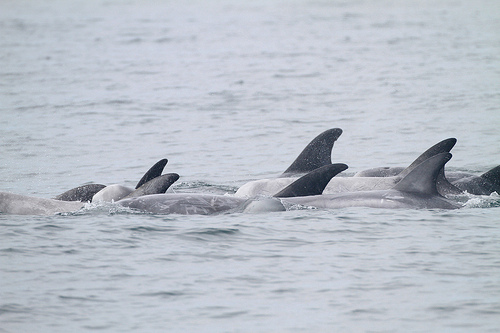 |
| Risso's Dolphins |
Our trip next Sunday is a go but we still need more seabirders for our October 29th trip. Come join us in the hunt!
Here is the link to our trip track of nearly 70 miles traveled:
http://share.gps.motionxlive.com/shr/x/kmz/4a3170dc3dad6a955d7b56f3d1bcdb5e - Google Maps
Ebird report by Blake Matheson: pelagic (inshore report below)
Here is the link to our trip track of nearly 70 miles traveled:
http://share.gps.motionxlive.com/shr/x/kmz/4a3170dc3dad6a955d7b56f3d1bcdb5e - Google Maps
Ebird report by Blake Matheson: pelagic (inshore report below)
American Wigeon  4
Northern Shoveler  80
Northern Pintail  200
Surf Scoter  40
Pacific Loon  30
Common Loon  2
loon sp.  5
Eared Grebe  3
Black-footed Albatross  8
Northern Fulmar  50
Pink-footed Shearwater  1300
Flesh-footed Shearwater  4
Buller's Shearwater  30
Sooty Shearwater  450
Short-tailed Shearwater  1
Sooty/Short-tailed Shearwater  3
Brandt's Cormorant  10
Brown Pelican  25
Red-necked Phalarope  120
Red Phalarope  15
Sabine's Gull  5
Bonaparte's Gull  2
Heermann's Gull  200
Western Gull  1000
Western x Glaucous-winged Gull (hybrid)  1
California Gull  800
Herring Gull  1
Glaucous-winged Gull  10
Common Tern  1
South Polar Skua  6
Pomarine Jaeger  10
Parasitic Jaeger  1
jaeger sp.  1
Common Murre  100
Xantus's Murrelet  6
Cassin's Auklet  40
Rhinoceros Auklet  200
Tufted Puffin  1
Inshore report:
Northern Shoveler  100
Northern Pintail  50
Surf Scoter  50
Pacific Loon  25
Common Loon  2
loon sp.  1
Eared Grebe  10
Western/Clark's Grebe  1
Pink-footed Shearwater  5
Sooty Shearwater  10
Brandt's Cormorant  80
Double-crested Cormorant  2
Pelagic Cormorant  1
Brown Pelican  120
Great Egret  4
Snowy Egret  4
Black Oystercatcher  2
Black Turnstone  7
Short-billed/Long-billed Dowitcher  4
Red-necked Phalarope  15
Bonaparte's Gull  2
Heermann's Gull  120
Mew Gull  1
Western Gull  150
California Gull  200
Glaucous-winged Gull  4
Elegant Tern  8
Common Murre  100
Pigeon Guillemot  2
Cassin's Auklet  2
Rhinoceros Auklet  30
Rock Pigeon  30
Monday, October 3, 2011
October 1 Trip Report
 |
| Xantus's Murrelet |
Text and photos by Blake Matheson copyright by permission only
Monterey Bay pelagic (MTY Co.), Monterey, US-CA
Oct 1, 2011 9:00 AM - 3:30 PM
Protocol: Traveling
30.0 mile(s)
Comments: On the Sea Wolf II with Roger Wolfe for a charter by Sac Audubon and the Mt. Diablo and Yolo Chapters. Leaders Todd Easterla, Blake Matheson and Fritz Steurer also Jim Holmes, Terry Colborn and Mark Cudney. Captained by Richard Ternullo.
A beautiful temperate day with very easy seas throughout. After inshore course, headed west to app. 20 miles out and then southward to Sur Ridge in search of the water temperature break. We found the large Albacore fleet busy landing a glut of Tuna in 64 degree F water (57.6 in the harbor). Trip notable for Skua slam, 12-15 (+) Xantus' Murrelets (all within the albacore zone, most fly-bys, but a couple approached at length and photographed) Flesh-footed Shearwater and a Greater White-fronted Goose at 20 miles+ offshore. Excellent views of 15-20 Northern Fur Seals,
 |
| Northern Fur Seal |
sub adult bull Elephant Seal, large Mola Mola. No rorquals, but good views early of breaching Risso's Dolphin inshore and bow-riding Dall's Porpoise.
More truly exceptional was a view of Pacific Swordfish (Ternullo could not recall the last time he'd seen one on Mty Bay). But, the real highlight came late in the day. While passing Cypress Point around 2:30 or 3:00, Ternullo saw the near lateral spume of a great whale. It blew repeatedly and we approached. The water roiled. At first we saw what we believed were two sperm whales. Drawing closer it became clear, however, these were not two whales but one enormous bull, with the massive leading edge of its head emergent some distance from the caudal peduncle of its tail. At this point there was no question we were in the company of Physeter macrocephalus, and an enormous specimen at that. The maximum size of Sperm Whale bulls is apparently a topic of some controversy. The Nantucket Whaling Museum has part of a jaw bone that is 18 feet long. Some claim the animal that bone came from would necessarily have been 80 feet at least. The whale that rammed and sank the Essex was said to have been 85 feet ("I turned around and saw him about one hundred rods directly ahead of us, coming down with twice his ordinary speed (25 knots), and it appeared with tenfold fury and vengeance in his aspect. The surf flew in all directions about him with the continual violent thrashing of his tail. His head about half out of the water, and in that way he came upon us, and again struck the ship." -Owen Chase, survivor]. Modernly, the biggest verifiable bull has measured in at 67 feet [Whitehead, H. (2002)]. While, of course, we can't say with any certainty how large this whale was, it gave an impression of true enormity compared to the Humpbacks and Grays we usually see on the Bay. There was no question this was a bull, and a superlative one at that. As we drew closer bottom readings put the depth at some 300 fathoms (1800 feet). We were near the Carmel canyon edge when the whale submerged and fluked up, with its tail stock nearly vertical. This appendage was also gargantuan in its own right, ridged and muscular.The fluke seemed surprisingly tiny next to the girth of his tailstock. We waited for the whale to resurface some 40 minutes before giving up and resuming our course back to the harbor. A few moments later we saw his spume again a final time, now far to the south beyond the wake line. This was the first Sperm Whale for most on board. It was Wolfe's first in North America. Ternullo has seen them only a handful in his many decades on the water. |
| Sperm Whale |
 |
| Sperm Whale |
 | ||
| South Polar Skua |
Here is a map of our route out to Sur Ridge and back: http://gps.motionx.com/maps/39a837e7bfea293f48a7af5e900aa475
offshore pelagic/ inshore Pt. Lobos to harbor
Greater White-fronted Goose  1     One seen 20 miles + offshore/ 1
Canada Goose  1     Another offshore goose roughly 20 miles off Pt. Sur.
teal sp.  4     In flight with Scoters a few miles off Pt. Pinos.
Surf Scoter  8/2
Common Loon 0/1
Pacific Loon0/4
Eared Grebe 0/2
Western Grebe 0/2
Black-footed Albatross  10
Northern Fulmar  6/1
Pink-footed Shearwater  120/2
Flesh-footed Shearwater  1
Buller's Shearwater  25
Sooty Shearwater  300/60
Sooty/Short-tailed Shearwater  1/1
Brandt's Cormorant  140/250
Double Crested Cormorant 0/4
Pelagic Cormorant 0/15
Brown Pelican  40/15
Great Blue Heron 0/1
Great Egret 0/5
Snowy Egret 0/2
Black Turnstone 0/6
Red-necked Phalarope  60/85
Red Phalarope  8/0
Sabine's Gull  3/0
Heermann's Gull  300/400
Western Gull  125/300
California Gull  250/440
Common Tern  2/0
Elegant Tern  6/50
South Polar Skua  18/0
Pomarine Jaeger  30/0
Parasitic Jaeger  4/12/0
Long-tailed Jaeger  2/0
Common Murre  25/80
Xantus's Murrelet  15/0
Xantus's Murrelet (scrippsi)  2/0
Cassin's Auklet  12/10
Rhinoceros Auklet  30/25
Rock Pigeon 0/25
Photo collage by Wendy Naruo:

Sunday, October 2, 2011
Sept. 17 trip report

Text by Don Roberson, Photos copyright by permission only Martijn Verdoes/www.agami.com
- Aboard 'Pt Sur Clipper' with Richard Ternullo, skipper; Roger Wolfe, Martin Verdoes, Matthew Dodder, Blake Matheson, Bruce Elliott and me (D. Roberson), leaders; with Ken Peterson, Peter White, Bill Sweetman and Michigan tour, and many whose names I did not get, including a couple from Texel. Overcast a.m., sunny & bright p.m. Winds light, Beaufort 2 a.m., Beaufort 3 p.m., but with a substantial swell from northwest. Route: Monterey harbor to Pt. Pinos, then W ~10 mi, north into SCZ waters (did Soquel Canyon & 'the fingers' for storm-petrels), then south into MTY waters some 16 nmi NW of Pt. Pinos, continuing S to 14 nmi W of Pt. Pinos, turn east and return. Lots of egg-yolk jellies still but few cetaceans: a couple of distant Humpbacks plus a bow-riding small pod of Pac White-sided Dolphin.
Monterey Pelagic/ inshore/ Santa Cruz Pelagic
Black-footed Albatross  12/0/7
Northern Fulmar  20/1/10
Pink-footed Shearwater  70/0/50
Buller's Shearwater  50/0/30
Sooty Shearwater  150/15/150
Ashy Storm-Petrel  4/0/2000
Black Storm-Petrel  1/0/10
Brandt's Cormorant  5/80
Pelagic Coromorant 0/8/0
Great Blue Heron 0/1/0
Great Egret 1/0/0
Peregrine Falcon 0/1/0
Red-necked Phalarope  40/30/30
Red Phalarope  8/0/0
Sabine's Gull  2/0/4
Heermann's Gull  5/100/10
Western Gull  200/150/150
California Gull  100/100/100
Arctic Tern  3/0/1
Elegant Tern 0/12/0
South Polar Skua  1/0/3    same bird as one in SCZ ~ 16.5 NW of Pt. Pinos, watched as it continued due south and was lost in distance in MTY
Pomarine Jaeger  7/0/6
Parasitic Jaeger  2/0/0
jaeger sp.  1/0/0
Common Murre  100/20/50
Pigeon Guillemot 0/3/0
Cassin's Auklet  50/0/10
Rhinoceros Auklet  40/2/30

Ashy Storm-petrel

Monterey Seabirders


 | ||
| Northern Fulmar |
 |
| Pomarine Jaeger kleptoparasitizing |
 | |
| Sabine's Gull |
 |
| Red-necked Phalaropes |
Sept. 10 trip report
It is strange how things change on the Monterey Bay. Last weekend’s trip we called the Sooty Shearwater Study Tour when we found only one each of Buller’s and Pink-footed Shearwaters. A week later we find more PINK-FOOTS than I’ve ever seen in one day on the bay. I estimate we saw about 1,000 for the day and they outnumbered the Sooties by a wide margin. There was a PFSH in view almost continuously after we passed Pt. Pinos.
All photos copyright by permission only Martijn Verdoes/www/agami.com
All photos copyright by permission only Martijn Verdoes/www/agami.com
 |
| Pink-footed Shearwater |
BULLER’S SHEARWATERS still remain scarce with only 16 seen on the day but we did manage to find a grand total of 3 FLESH-FOOTED SHEARWATERS to the excitement of the visiting group of birders from Denmark. The shot below is not photoshopped!
 |
| Flesh-footed (L) and Pink-footed Shearwaters |
The first of fall SHORT-TAILED SHEARWATER was photographed by Martijn Verdoes to give us five species of shearwater for the day.
Martijn adjusted the size of the Sooty in this photoshopped comparison so it would match the Short-tailed Shearwater on the right.

We were able to achieve the Skua Slam with sightings of PARASITIC, POMARINE and LONG-TAILED JAEGERS and 2 SOUTH POLAR SKUAS.
Other good bonus birds seen this day included 2 BLACK TERNS and a single TUFTED PUFFIN.
 |
| Tufted Puffin |
Weirdest sighting of the day was of a DOUBLE-CRESTED CORMORANT that we saw 10 miles from land. Add 2 BROWN-HEADED COWBIRDS and a TOWNSEND’S WARBLER and we totaled 28 species on the day which is pretty good for a Monterey Bay pelagic.
 |
| Brown-headed Cowbird and friend |
eBird report
Monterey Bay pelagic (MTY Co.), Monterey, US-CA Sep 10, 2011 8:15 AM - 2:45 PM Protocol: Traveling 40.0 mile(s) Comments: Monterey Seabirds trip w/ Todd Easterla, Martijn Verdoes, Matthew Dodder, Richard Ternullo skipper and Alex Rinkert chummer. Also Martin Meyers and Ken Peterson and the Danish Field Ornithologists (DOF) Confused seas and wind kept us from going to the north coast so we spent the day in Monterey County waters. Seas were Beaufort 3 at times with high overcast marine layer all day but good visibility. 28 species (+1 other taxa)
Black-footed Albatross 100
Northern Fulmar 25
Pink-footed Shearwater 1000
Flesh-footed Shearwater 3
Buller's Shearwater 16
Sooty Shearwater 750
Sooty/Short-tailed Shearwater 1 photographed
Ashy Storm-Petrel 10
Double-crested Cormorant 1 10 miles from shore
Brown Pelican 30
Red-necked Phalarope 12
Red Phalarope 20
Sabine's Gull 20
Heermann's Gull 50
Western Gull 80
California Gull 30
Black Tern 2
Common Tern 5
Elegant Tern 3
South Polar Skua 2
Pomarine Jaeger 8
Parasitic Jaeger 8
Long-tailed Jaeger 10
Common Murre 300
Cassin's Auklet 15
Rhinoceros Auklet 120
Tufted Puffin 1
Townsend's Warbler 1
Brown-headed Cowbird 2
Thursday, September 8, 2011
iPhonescoping
I like to travel light when I go birding. Carrying around a camera body with a long lens isn't something that appeals to me. Not that there's anything wrong with that. I am not into doing bird photography on my usual rounds at favorite locales unless of course I find something rare enough that requires documentation. Just in case I do find something that needs to be documented I've carried a small digital camera to use for digiscoping but invariably it seems the batteries have run down every time I try to use it. Backup batteries would be a good idea but I've had them go bad on me too. Video cameras are a good way to document rarities but once again you've got to worry about battery power and you have to carry it in some sort of fanny pack or backpack.
Recently I got an Iphone after having used a Itouch for a year and I immediately started enjoying using the camera and video camera on it. Wheels began to turn. I almost always have my phone with me and it is usually powered up sufficiently when I leave the house. It can slip into my pocket to carry. Surely there must be a way to use it in conjunction with a scope like you do with a digital camera for digiscoping.
I did some searching on the web and the could only find one blog by Rich Hoyer that shows how to do a handheld digiscope with the Iphone: http://birdingblogs.com/2011/richhoyer/digiscoping-with-an-iphone-%E2%80%93-northern-pygmy-owl-and-greater-white-fronted-goose
But try as I may I was never able to get a very good shot with the hand held method. It was extremely difficult to keep the camera centered on the exit pupil. None of my images came out recognizable.
In trying to come up with a way to attach the iPhone to the scope I stumbled upon the Joby Gorillapod Flex Tripod for the iPhone 4. It has a case that encloses the phone so it can be attached to the flexible tripod.
I bought mine from Amazon for $10.90. I then took my scope and readjusted the handle closer to the lense and voila I had a stable platform to shoot through my scope. It takes a bit of practice to adjust the camera onto the exit pupil image and you will see some vignetting that can be remedied by zooming in with the camera app. I'm using the Lightbox app that has an image stabilizer that helps with the phonescoping and a self timer. The standard camera app works well too and you can switch it over to video too as well as shoot in HDR but does not have zoom capability.
I wrap two of the flexible arms of the gorillapod over the handle on the fluid head in opposite directions. with the third arm pushed against the top of the scope for additional stability. Not all fluid heads come with the adjustable handle, mine adjusts with a simple turn of a wingnut. (Manfrotto 3130) I carry the flexipod wrapped around the handle just in case I need it for phonescoping.
Here is what it looks like:

One small problem is that the case that goes on the iPhone slides onto the wrong side of the iPhone for using the camera so you will need to snap it on and off. To get it off you will need to snap apart the case and slide the attachment off that way.
I tried it out the the other day down at the Pajaro River under extremely foggy conditions. I'm sure the photos could have been done better under more favorable conditions. Obviously it is no magazine cover but it is sufficient for photo documentation and I did edit the sharpness a little:

The video I shot was even better and next time I should be able to eliminate the vignetting by zooming in:
http://www.youtube.com/watch?v=i6dYZ17yhzA
I'm looking forward to working out some of the kinks and hopefully I will find some rare shorebird to try it out on!
If you have any suggestions I'd love to hear from you.
tt
Recently I got an Iphone after having used a Itouch for a year and I immediately started enjoying using the camera and video camera on it. Wheels began to turn. I almost always have my phone with me and it is usually powered up sufficiently when I leave the house. It can slip into my pocket to carry. Surely there must be a way to use it in conjunction with a scope like you do with a digital camera for digiscoping.
I did some searching on the web and the could only find one blog by Rich Hoyer that shows how to do a handheld digiscope with the Iphone: http://birdingblogs.com/2011/richhoyer/digiscoping-with-an-iphone-%E2%80%93-northern-pygmy-owl-and-greater-white-fronted-goose
But try as I may I was never able to get a very good shot with the hand held method. It was extremely difficult to keep the camera centered on the exit pupil. None of my images came out recognizable.
In trying to come up with a way to attach the iPhone to the scope I stumbled upon the Joby Gorillapod Flex Tripod for the iPhone 4. It has a case that encloses the phone so it can be attached to the flexible tripod.
 |
| Joby Gorillapod, snap on case w/iPhone |
 | ||
| Joby Gorillapod with iPhone |
I wrap two of the flexible arms of the gorillapod over the handle on the fluid head in opposite directions. with the third arm pushed against the top of the scope for additional stability. Not all fluid heads come with the adjustable handle, mine adjusts with a simple turn of a wingnut. (Manfrotto 3130) I carry the flexipod wrapped around the handle just in case I need it for phonescoping.
Here is what it looks like:

 |
| Left side |
 | |||||
| Right side |
One small problem is that the case that goes on the iPhone slides onto the wrong side of the iPhone for using the camera so you will need to snap it on and off. To get it off you will need to snap apart the case and slide the attachment off that way.
I tried it out the the other day down at the Pajaro River under extremely foggy conditions. I'm sure the photos could have been done better under more favorable conditions. Obviously it is no magazine cover but it is sufficient for photo documentation and I did edit the sharpness a little:

The video I shot was even better and next time I should be able to eliminate the vignetting by zooming in:
http://www.youtube.com/watch?v=i6dYZ17yhzA
I'm looking forward to working out some of the kinks and hopefully I will find some rare shorebird to try it out on!
If you have any suggestions I'd love to hear from you.
tt
Subscribe to:
Comments (Atom)